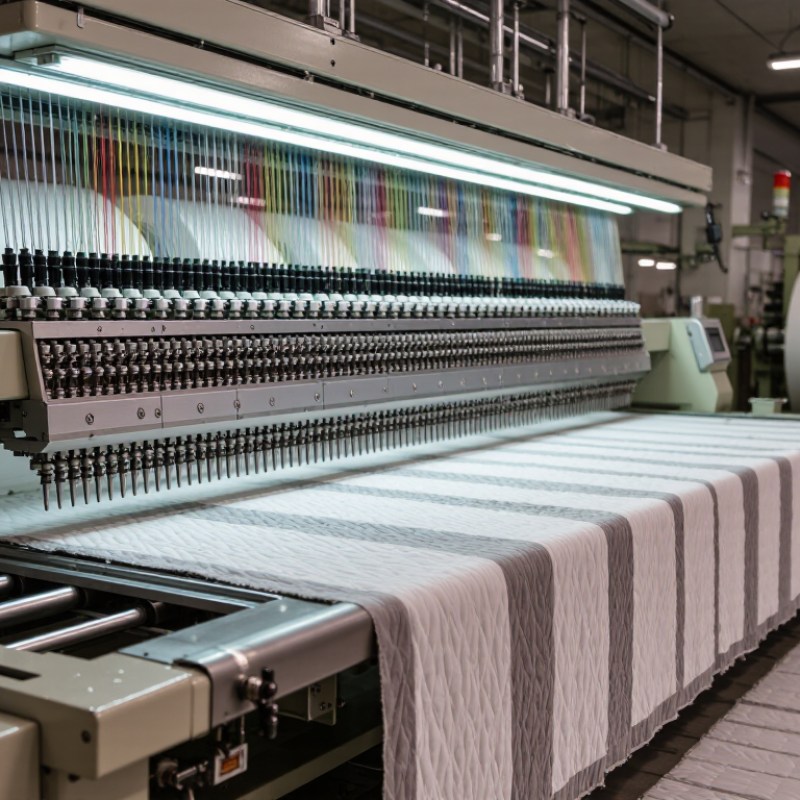
| Machine Definition | A computer-controlled quilting system equipped with multiple needle positions or needle heads. | Automates repeated quilting patterns on layered materials such as a quilt top, batting, and backing. |
| Needle Configuration | Common configurations include 2, 3, 5, 6, 8, or more independently selectable needles, depending on machine design. | Allows different thread colors or sewing positions to be selected without manually replacing the needle for every design change. |
| Needle Gauge | The center-to-center distance between adjacent needles is commonly specified in millimeters; fine gauges may be around 1/4 inch, while wider gauges may be approximately 1/2 inch or more. | Determines stitch spacing, quilting density, and the minimum distance between parallel rows. |
| Needle System | Industrial quilting machines use a specified needle system and size range selected according to fabric weight, thread type, and machine specifications. | Correct needle selection helps reduce skipped stitches, thread breakage, fabric damage, and uneven stitch formation. |
| Needle Bar Assembly | A rigid bar or group of bars carries the needles and moves them vertically in a synchronized cycle. | Maintains consistent needle timing and penetration across the quilting width. |
| Hook and Bobbin System | Rotary or oscillating hooks interlock the upper needle thread with bobbin thread beneath the fabric layers. | Forms the lockstitch and influences stitch reliability, thread tension, and maintenance requirements. |
| Presser Foot and Feed Mechanism | The presser foot holds the quilt layers while feed rollers, belts, or a moving frame advances the material. | Supports stable fabric movement and helps maintain uniform stitch length. |
| Computerized Control | A control panel or industrial computer manages needle selection, pattern data, speed, stitch length, and machine status. | Improves repeatability and allows operators to store, adjust, and reproduce quilting patterns. |
| Pattern Input | Patterns may be entered through a touchscreen, removable storage, network connection, or compatible design software. | Enables geometric, decorative, border, and edge-to-edge quilting designs to be transferred to the machine. |
| Quilting Speed | Industrial multi-needle systems commonly operate at several hundred to more than 1,000 stitches per minute, depending on material and pattern. | Higher speed increases production capacity, but actual output depends on design complexity, thread, fabric thickness, and operator settings. |
| Stitch Length Control | Electronic control typically allows stitch length to be set for the selected fabric and quilting pattern. | Helps maintain balanced stitches when the machine accelerates, decelerates, or changes direction. |
| Thread Management | Thread guides, tension units, take-up levers, and thread-break sensors manage and monitor each needle thread path. | Supports consistent tension and can pause the machine when a thread breaks or runs out. |
| Quilt Width | Working widths vary by machine class; compact systems may handle narrow panels, while production systems can process wide quilt rolls. | The usable width affects product size, layout efficiency, and the number of passes required. |
| Suitable Materials | Typical materials include cotton, polyester, blended fabrics, nonwoven batting, and other compatible textile layers. | Material compatibility depends on thickness, compressibility, surface friction, thread, and needle selection. |
| Primary Advantages | Multi-needle operation, computerized pattern control, repeatable stitch quality, reduced manual needle changes, and improved production consistency. | Best suited to repeated quilting work where accuracy, speed, and consistent decorative results are important. |