How to Choose the Right Photoelectric Sensors for Your Needs?
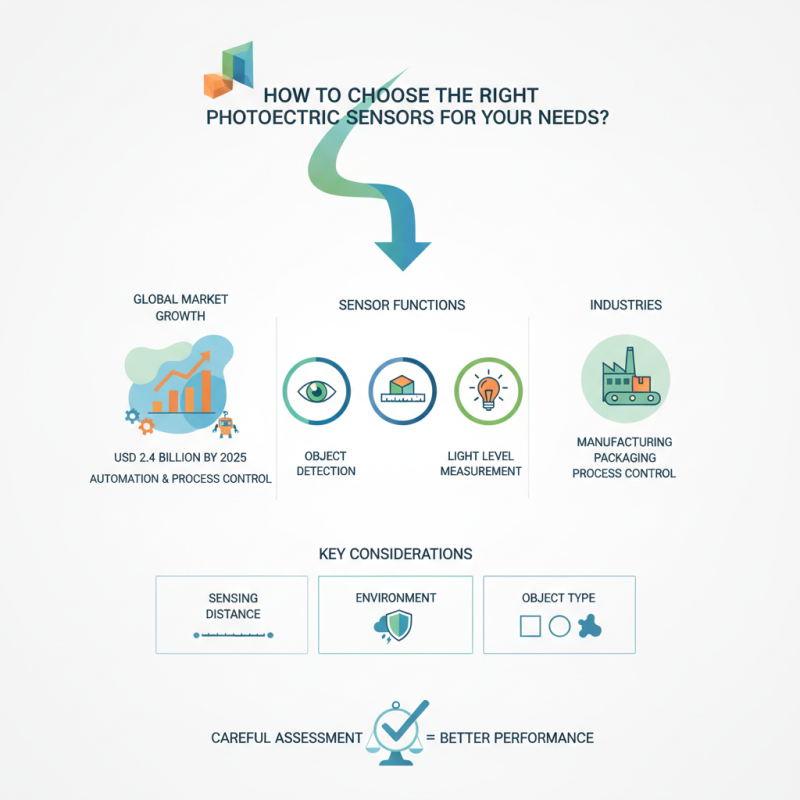
Choosing the right Photoelectric Sensors can significantly impact industrial efficiency. A report by MarketsandMarkets states that the global photoelectric sensor market is projected to reach USD 2.4 billion by 2025. This growth highlights the crucial role these sensors play in automation and process control.
Photoelectric sensors detect objects, measure distance, and assess light levels. They are vital in many industries, from manufacturing to packaging. Yet, the variety of types can be overwhelming. Understanding your specific needs helps in selecting the right sensor.
Consider factors like sensing distance, environment, and object type. For instance, a robust sensor may be mandatory in harsh conditions. However, some applications may not require this level of durability. Not all photoelectric sensors will suit your task. We often overlook this complexity, yet a careful assessment leads to better performance and fewer failures in the long run.
Understanding the Basics of Photoelectric Sensors and Their Functions
Photoelectric sensors are essential in many applications, from industrial automation to safety systems. They operate by detecting changes in light and converting this information into an electrical signal. Understanding how these sensors work can greatly enhance your selection process.
There are several types of photoelectric sensors, like proximity, retro-reflective, and through-beam. Each type has unique features suited for different environments. For instance, proximity sensors can detect objects without physical contact, making them useful in tight spaces. Retro-reflective sensors often have long ranges, while through-beam sensors are excellent for precise detection. It's crucial to evaluate your needs before choosing a type.
However, the selection process can be tricky. Environmental factors may affect sensor performance. Dust, fog, or obstructions can lead to false readings. Sometimes, a sensor may not work as expected in harsh conditions. It’s important to consider these limitations when making your choice. Proper testing and feedback from real-world applications can help refine your decision. This reflective approach can save time and resources in the long run.
Photoelectric Sensor Types and Their Applications
Identifying Your Specific Application Requirements for Sensor Selection
When selecting photoelectric sensors, defining your application requirements is crucial. Start by understanding the environmental conditions where the sensors will operate. Research indicates that around 40% of sensor failures come from inadequate consideration of these conditions. High humidity or dust can affect performance. Ensure the sensor chosen is rated for such challenges.
Next, identify the required sensing range. Different applications demand different ranges. Studies show that in industrial settings, a range of 15 to 20 meters is common but not universal. If your application involves detecting small objects, a sensor with a shorter range might be necessary. Sensors with adjustable ranges can add flexibility, but they often come with increased complexity.
Don’t overlook the type of output signal you need. Certain applications may require analog signals, while others need digital outputs. This choice heavily influences compatibility and ease of integration. Some users might struggle with the differences. Accurate documentation and user feedback on issues can provide insight into real-world applications. Research shows that 25% of users faced challenges integrating new sensors into existing systems. Understanding your specific needs can help avoid such pitfalls.
How to Choose the Right Photoelectric Sensors for Your Needs?
| Application | Sensor Type | Detection Range | Output Type | Environment |
| Packaging | Through-beam | 0.1 - 10 meters | NPN | Indoor Condition |
| Material Handling | Reflex | 0.05 - 5 meters | PNP | Dusty Environment |
| Automated Assembly | Diffuse | 0.01 - 1 meter | Relay | Clean Room |
| Textile Industry | Smart Sensor | 0.5 - 3 meters | NPN | High Humidity |
| Logistics | Photoelectric | Up to 15 meters | PNP | Outdoor Condition |
Comparing Different Types of Photoelectric Sensors Available in the Market
When selecting photoelectric sensors, understanding the different types available is crucial. These sensors fall into several categories, including through-beam, retro-reflective, and diffuse-reflective. Each type has distinct applications and benefits. For example, through-beam sensors excel in long-range detection, while diffuse-reflective sensors are compact and suitable for detecting close objects. Depending on your situation, one type may outperform the others significantly.
Tips: Consider the distance you need to cover. If it's more than a few meters, through-beam is likely the best choice. Assess the environment too. Dusty locations might affect performance, so choose sensors designed to handle such conditions.
Furthermore, ensure compatibility with your system. Some sensors require specific voltage levels or interfaces. It's wise to look at the specifications in detail. Sometimes, users assume that all sensors will easily integrate, but this can lead to issues. Take time to research before making a decision.
Tips: Always test sensors before full implementation. This trial can reveal hidden flaws. Read user reviews for insights, but remember that experiences can vary. Reflect on how different features meet your needs, and don't hesitate to ask experts for advice.
Evaluating Key Features and Specifications of Photoelectric Sensors
When selecting photoelectric sensors, understanding their key features is essential. These sensors vary in type, such as through-beam, retro-reflective, and diffuse. Each has distinct applications. Through-beam sensors are excellent for long distances. Retro-reflective models are easier to set up but can be affected by reflective surfaces. Choose according to your needs and environment.
The sensing range is critical for performance. Check the manufacturer’s specifications for distance and object size. Sensitivity settings may adjust to different settings. Strong ambient light can interfere. Consider environmental factors—dust and moisture can impact reliability. You might overlook these details but they matter significantly.
Power requirements also differ. Some sensors operate on low voltage while others need higher wattage. Consider energy efficiency if applicable. Mounting options vary too. Flexible installation can save time. Ensuring compatibility with your existing systems may pose a challenge, but it is worth addressing. Each choice you make shapes the functionality of your sensors.
Assessing Environmental Factors and Compatibility in Sensor Choice
Choosing the right photoelectric sensor involves understanding the specific environmental factors at play. For instance, humidity can significantly affect sensor performance. According to a recent industry report, moisture levels above 70% can lead to false readings in certain sensors. This makes it vital to assess installation locations carefully. Consider moisture-resistant options or enclosures for protection.
Temperature is another critical factor. Sensors typically function optimally within specified temperature ranges. Deviations can result in reduced sensitivity or even sensor failure. A study by the Automation Technology Association indicates that 30% of sensor failures are attributed to temperature extremes. Addressing this requires thorough analysis before installation. It’s essential to choose sensors that can withstand expected environmental fluctuations.
Additionally, consider compatibility with existing systems. Not every sensor integrates smoothly with current setups. Research indicates that 40% of integration issues stem from mismatched technologies. Collaboration with engineering teams may be necessary to ensure a seamless fit. Some unexpected challenges may arise. These factors highlight the importance of careful planning and consideration during the selection process.